
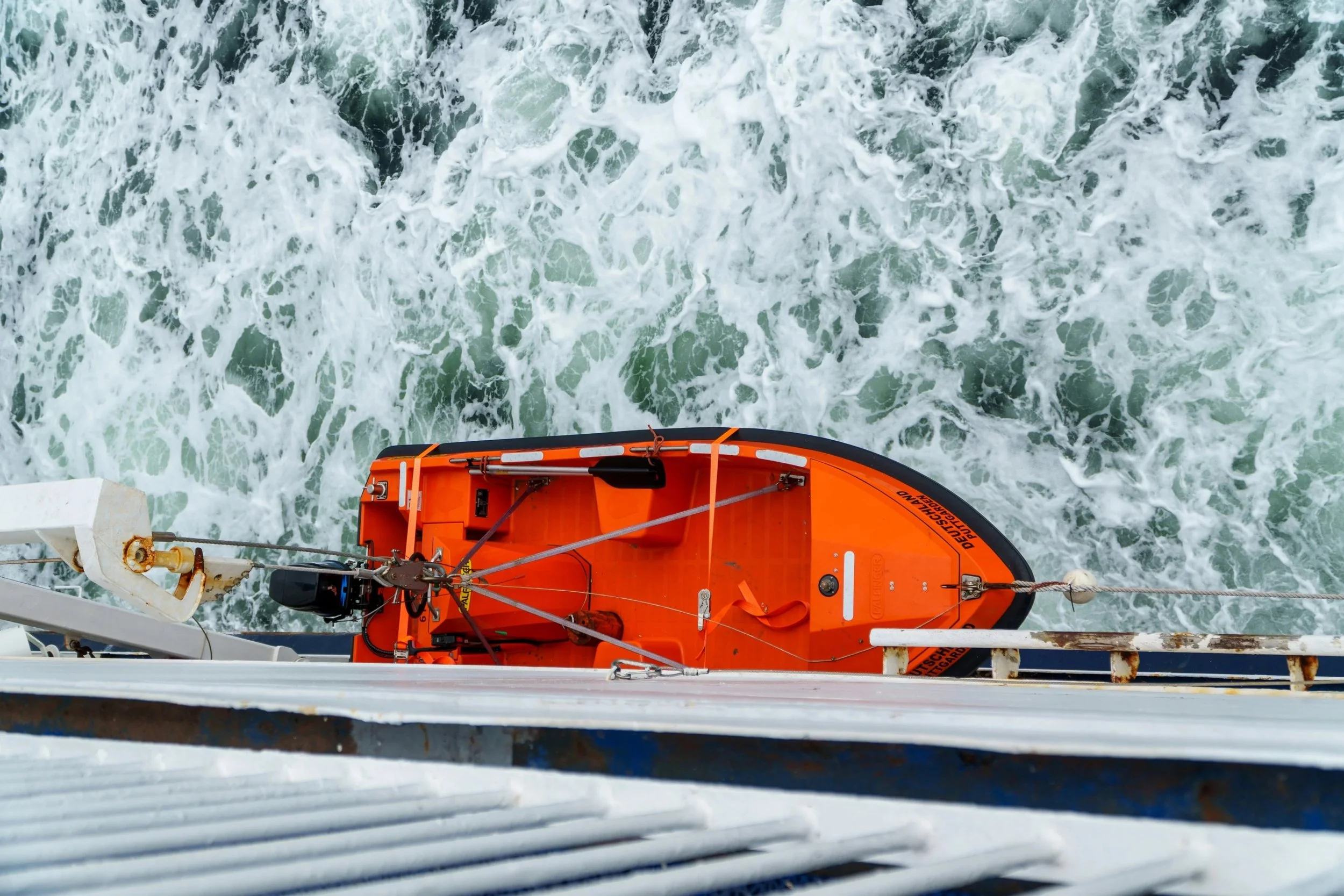
The Life Boat
Same Boat, Same Grace
A ship has gone down at sea. Everyone who made it out alive is now crammed into the same lifeboat. Some climbed in soaking wet and shaking, having just barely escaped drowning in a besetting sin. Others have been in the boat a little longer — they've dried off, found their footing, learned where to sit so the boat doesn't rock so much.
But here's the truth underneath all of it: every single person in that boat was pulled from the same water. Nobody swam to the boat under their own strength. Nobody earned a seat by treading water longer than the next person. They were rescued. Full stop.
That boat is salvation. That water is sin. And the rescue — the strong hand that reached down and pulled each person up over the side — that's grace.
Hold that picture in your mind, because we're going to keep coming back to it. It's simple enough for a child to get and deep enough to keep unpacking for the rest of your life.
The Truth That Levels Everyone
"For all have sinned and fall short of the glory of God, and are justified freely by his grace through the redemption that came by Christ Jesus." — Romans 3:23–24 (NIV)
Paul doesn't say "some have sinned" or "the really bad ones have sinned." All. Every single occupant of the boat came from the same water. There's no VIP section, no first-class cabin, no dry-and-arrived-early corner reserved for people who somehow didn't need rescuing.
"God saved you by his grace when you believed. And you can't take credit for this; it is a gift from God. Salvation is not a reward for the good things we have done, so none of us can boast about it." — Ephesians 2:8–9 (NLT)
Read that phrase again: you can't take credit for this. Nobody rowed themselves to safety. Nobody's effort put them in the boat. And that single fact quietly levels every person sitting inside it — the person who's been a believer for forty years and the person who prayed their first real prayer last night.
This is the foundation everything else in this lesson stands on. If you skim past it, the rest won't make sense. So sit with it for a second: you are in the boat because you were rescued, not because you were good enough to deserve a seat.
When We Forget: Looking Down on Others
Here's what tends to happen once we've been in the boat a while and dried off some. We start comparing ourselves to the person still shivering nearby, and something in us whispers, I'm doing better than they are. Maybe we don't say it out loud. But we feel it. A quiet superiority. A little more distance than there used to be.
"You, then, why do you judge your brother or sister? Or why do you treat them with contempt? For we will all stand before God's judgment seat." — Romans 14:10 (NIV)
Paul isn't asking a rhetorical question just to be poetic — he's confronting something real in the early church, and something real in us. The moment we start ranking who's "more saved" or "less messed up," we've quietly stepped outside the truth of the boat.
Jesus told a story that nails this exact temptation:
"Two men went up to the temple to pray, one a Pharisee and the other a tax collector. The Pharisee stood by himself and prayed: 'God, I thank you that I am not like other people — robbers, evildoers, adulterers — or even like this tax collector. I fast twice a week and give a tenth of all I get.' But the tax collector stood at a distance. He would not even look up to heaven, but beat his breast and said, 'God, have mercy on me, a sinner.' I tell you that this man, rather than the other, went home justified before God." — Luke 18:10–14 (NIV)
The Pharisee never actually left the boat. He just forgot he was ever in the water. He looked at the man next to him and saw a scorecard, not a fellow rescued sinner. Dry clothes have a way of making us forget we were ever soaked and gasping for air.
Jesus pushes even harder on this in the Sermon on the Mount:
"Why do you look at the speck of sawdust in your brother's eye and pay no attention to the plank in your own eye?" — Matthew 7:3 (NIV)
And Paul, writing to a church full of people who loved comparing spiritual résumés, puts it plainly:
"So let's not condemn each other anymore. Decide instead to live in such a way that you will not cause another believer to stumble and fall." — Romans 14:13 (NLT)
The call isn't to stop caring about sin. It's to stop pretending we're somehow watching from outside the boat when we're sitting right in it.
When We Forget: Writing Ourselves Off
There's an opposite danger, and it's just as destructive. Some people look at their own sin — especially a sin they keep returning to, or one that feels uniquely shameful — and quietly conclude they don't belong in the boat at all. I'm too far gone. Too stained. Too much of a repeat offender to really be saved.
But the boat was never about being clean enough to deserve a seat. It was about being rescued because you couldn't save yourself. That's not a loophole in the gospel — it's the whole point of it.
"This is a trustworthy saying, and everyone should accept it: 'Christ Jesus came into the world to save sinners' — and I am the worst of them all." — 1 Timothy 1:15 (NLT)
Think about who wrote that. Paul — the man responsible for most of the New Testament, who planted churches across the ancient world, who suffered beatings and shipwrecks and imprisonment for the gospel — called himself the worst of sinners. Present tense. Years into his ministry. He didn't say "I used to be the worst." He didn't disqualify himself from the boat because of his past or his ongoing struggles. He let that truth drive him deeper into grace, not further from it.
"But if we confess our sins to him, he is faithful and just to forgive us our sins and to cleanse us from all wickedness." — 1 John 1:9 (NLT)
Notice the promise isn't "he will forgive you eventually, once you've proven you've really changed." It's immediate, and it's complete. All wickedness.
There's another verse worth sitting with here:
"Come to me, all who labor and are heavy laden, and I will give you rest." — Matthew 11:28 (ESV)
Jesus doesn't say "come to me once you've cleaned yourself up." He says come as you are, heavy laden — soaking wet, gasping, mid-drowning. That's the only way anyone ever comes.
Here's the uncomfortable truth: self-condemnation dresses itself up as humility, but it's often a subtler form of pride — insisting that your sin is the one exception grace can't actually cover. It puts you, not the cross, at the center of the story.
Different Growth, Same Boat
Not everyone in the boat is in the same place, and that's not a flaw in the system — it's just what rescue looks like in real time. Some have been walking with Christ for decades. Others climbed in last night. Some are steady and calm; others are still catching their breath, coughing up water.
"Dear brothers and sisters, if another believer is overcome by some sin, you who are godly should gently and humbly help that person back onto the right path. And be careful not to fall into the same temptation yourself." — Galatians 6:1 (NLT)
Notice what this verse quietly assumes: the person doing the restoring and the person caught in sin are on the exact same level. "Be careful not to fall into the same temptation yourself" only makes sense if you're standing in the boat with them, not looking down from somewhere drier and safer.
"So it is with Christ's body. We are many parts of one body, and we all belong to each other." — Romans 12:5 (NLT)
"If one part suffers, all the parts suffer with it, and if one part is honored, all the parts are glad." — 1 Corinthians 12:26 (NLT)
That's the boat. One body. One rescue. Different scars, different stages of healing, same water everyone came out of.
Holding Both Truths at Once
The goal of this lesson isn't to pretend sin doesn't matter, or that spiritual growth is some illusion, or that maturity means nothing. It's to hold two things together without letting go of either one:
No one is in the boat because they earned it — so there's no room for looking down on someone still struggling.
No one is disqualified from the boat because of what they've done — so there's no room for writing yourself off.
"For God has bound everyone over to disobedience so that he may have mercy on them all." — Romans 11:32 (NIV)
"It is because of the LORD's great love we are not consumed, for his compassions never fail. They are new every morning; great is your faithfulness." — Lamentations 3:22–23 (NIV)
Everyone in the boat is equally rescued and equally dependent, every single day, on mercies that renew before the sun even comes up. That truth should produce two things in you at once: humility toward the person next to you, and hope for yourself.
The Takeaway
The lifeboat doesn't have first class and steerage. It doesn't rank passengers by how dry they've gotten or how long they've been aboard. Everyone in it was drowning. Everyone in it was pulled out by the very same hand.
That's the ground every believer actually stands on — not merit, but mercy.
And once you really believe that, in your bones and not just your head, something starts to loosen. Judgment toward others loses its grip. Despair over yourself loses its grip. What's left is gratitude — the kind that makes you want to reach back into the water and help pull the next person in.
"Freely you have received; freely give." — Matthew 10:8 (NIV)
You were rescued. Now go help rescue someone else. That's not a burden — it's the most natural thing in the world for someone who remembers what the water felt like.
Take Action:
Name your "dry clothes." Think of one area where you feel spiritually strong or "put together." Ask yourself honestly: have I let that turn into quiet superiority toward someone still struggling there?
Identify one person you've judged. Not to confront them — just to be honest with God about it. Pray for them by name, and ask God to help you see them as a fellow passenger in the boat, not someone beneath you.
Speak truth to your own shame. If there's a sin you keep using as evidence that you don't really belong, write down 1 Timothy 1:15 or 1 John 1:9 somewhere you'll see it, and let it talk back to that thought this week.
Practice Galatians 6:1 restoration. If you see a brother or sister caught in something, try approaching them the way the verse describes — gently, and aware that you could be the one struggling next. Notice how that changes the conversation.
Thank God for someone further along than you — and encourage someone earlier in the journey. Reach out to one person ahead of you in faith and thank them for their example, and one person behind you and offer encouragement, not correction.
The Conversation:
Where's your boat right now? Would you say you're still shaking off the water, or have you dried off enough that you've started to forget what it felt like to be rescued? What does that tell you about where you are right now?
Who have you quietly looked down on — even just in your thoughts — because their struggle looks different from yours? What would it look like this week to remember you're sitting in the same boat as them?
Is there a sin or a season of your life you've let convince you that you're "too far gone"? Read 1 Timothy 1:15 and 1 John 1:9 together — what do those verses say back to that belief?
Galatians 6:1 says to restore someone "gently" while watching yourselves. Is there someone in your life right now you sense you're supposed to help restore? What's held you back — fear, judgment, or something else?
If grace really does level the boat — no first class, no steerage — how would that change one specific relationship or habit in your life if you actually lived like it was true this week?