
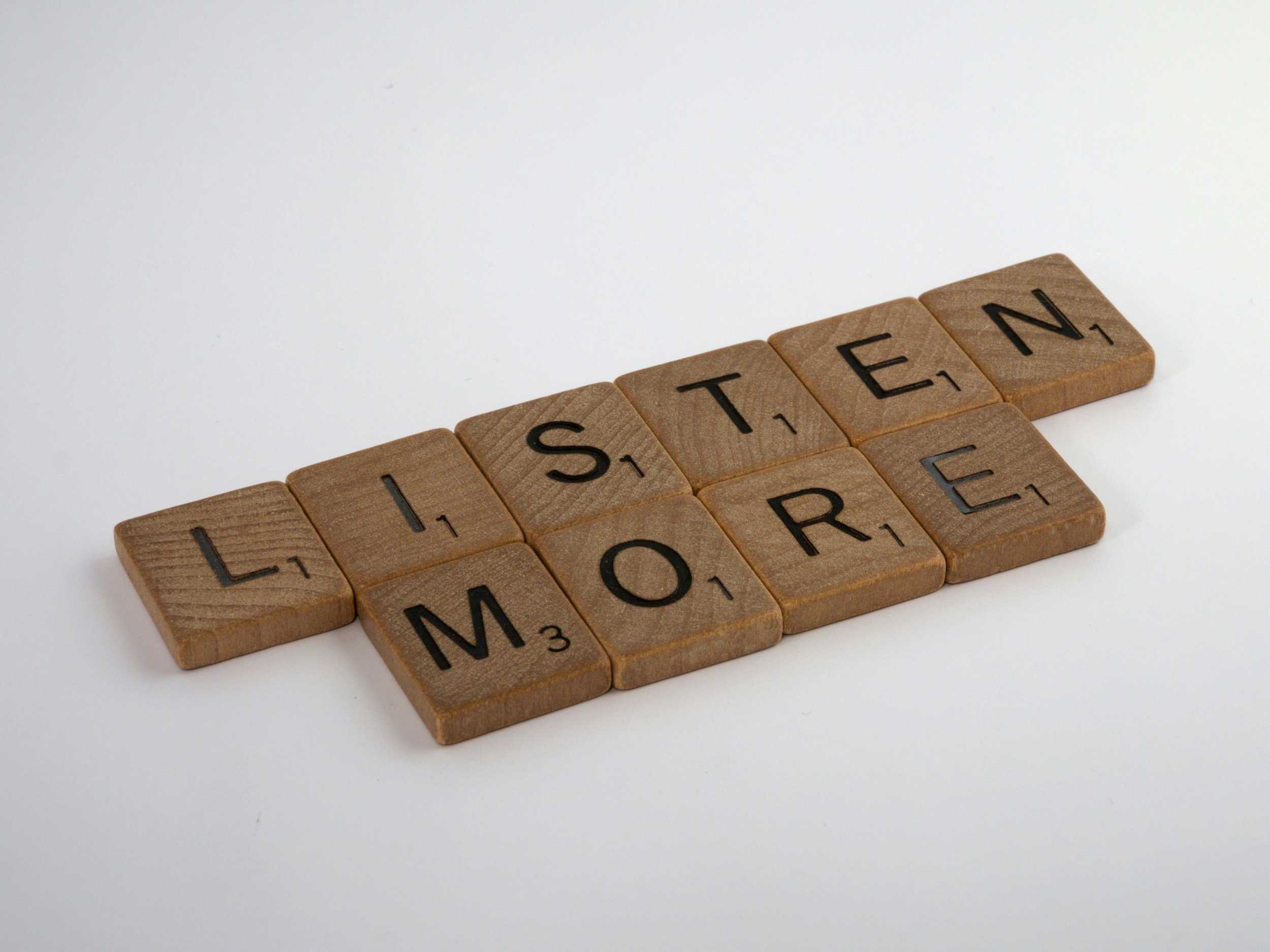
Active Listening
Have You Ever Really Been Heard?
Here's a question worth sitting with for a second: when was the last time you felt truly listened to? Not just heard — listened to. Where the other person put their phone down, stopped rehearsing their reply in their head, and actually tracked with you, word for word, feeling for feeling?
If you had to think hard to remember, you're not alone. Most of us are pretty bad listeners, even when we don't mean to be. We're waiting for our turn to talk. We're half-formulating advice before the other person finishes their sentence. We're distracted, tired, or quietly assuming we already know what they're going to say next.
But here's the thing: listening well might be one of the most loving things you can do for another human being. It says, without a single word, "You matter enough for me to stop and pay attention." And if we want to grow in connection, community, and communication, active listening isn't optional — it's foundational. You cannot build real relationship with someone you have never really heard.
Scripture has a lot to say about this. James, writing to early believers scattered across the ancient world, gave this simple but piercing instruction:
"Know this, my beloved brothers: let every person be quick to hear, slow to speak, slow to anger." — James 1:19 (ESV)
Notice the order. Quick to hear comes first — before speaking, before reacting, before forming an opinion. Listening is the starting point of wisdom, not an afterthought tacked on at the end of a conversation. And notice what follows it: slowness to anger. That's not a coincidence. So much of our anger in relationships comes from feeling unheard ourselves, or from reacting to something we only half-understood in the first place. Listening well diffuses conflict before it ever has the chance to ignite.
Proverbs adds a warning for those of us who love to jump in with answers before we've really heard the other person out:
"If one gives an answer before he hears, it is his folly and shame." — Proverbs 18:13 (ESV)
That's a strong word — folly. It's not merely impolite to answer before listening well; it's foolish. It damages trust, and it usually gets the response wrong entirely, because we ended up responding to what we assumed rather than to what was actually said. Solomon understood something we still forget in the age of instant replies: speed is not wisdom. Slowness, in this case, is.
The good news is that active listening is a skill. It can be learned, practiced, and strengthened — like a muscle that gets stronger the more you use it. Let's go deeper.
Why Listening Is So Hard
Before we get to the "how," it helps to be honest about the "why not." If listening well were easy, we'd all already be doing it. Here are some of the real barriers that get in the way. See if you recognize yourself in any of these.
We listen to defend, not to understand. When someone brings up a concern — especially about us — our instinct is often self-protection. We start building our case before they've even finished talking. Proverbs 18:13 is describing exactly this reflex: the answer forming in our mouth before the story has finished landing in our ears.
We're addicted to our own voice. Some of us fill silence out of nervousness. Others fill it because we genuinely believe our input is the most valuable thing in the room. Either way, a full mouth makes for empty ears. There's a strange kind of pride hidden inside constant talking — the assumption that what we have to say matters more than what's being said to us.
We're distracted by noise — external and internal. It's not just phones, although phones are a big part of it. It's the to-do list running in the back of your mind, the argument you had earlier, the hunger, the fatigue, the next meeting. Real listening requires quieting more than just your mouth; it requires quieting your whole inner world for a few minutes.
We confuse hearing with understanding. You can technically hear every word someone says and still miss them entirely — because you never stopped to ask what those words actually meant to them. Two people can use the same sentence and mean two very different things by it.
We're afraid of what we might hear. Sometimes we avoid deep listening because we're afraid of the emotion, the need, or the responsibility that comes with truly understanding someone's pain. It's easier, and safer, to stay on the surface.
Job's Friends: A Cautionary Example
Job's friends offer a striking biblical picture of this tension. They actually started well. When they arrived and saw the depth of Job's suffering, Scripture tells us:
"And they sat with him on the ground seven days and seven nights, and no one spoke a word to him, for they saw that his suffering was very great." — Job 2:13 (ESV)
Seven days of silent presence. No advice. No theology lectures. Just showing up and sitting in the dust beside a grieving friend. That is active listening in its purest, most costly form — the willingness to be present without needing to fix, explain, or perform.
But once they opened their mouths, everything changed. They stopped listening to Job and started lecturing him with their own theories about why he was suffering. Chapter after chapter, their words caused more damage than their silence ever did. It's a sobering reminder that even good intentions can curdle into bad listening the moment we decide we already know what the other person needs to hear.
Jesus: A Masterclass in Active Listening
Contrast that with Jesus. Again and again in the Gospels, we see Him ask questions He already knew the answers to — not because He needed information, but because He wanted the person in front of Him to be truly known and heard. When a blind beggar named Bartimaeus cried out to Him along the road, Jesus didn't just heal him on the spot. He stopped, and He asked:
"And Jesus said to him, 'What do you want me to do for you?' And the blind man said to him, 'Rabbi, let me recover my sight.'" — Mark 10:51 (ESV)
That question is a masterclass in active listening. Jesus could see the man was blind. The need seemed obvious. He could have simply healed him and walked on. But He still asked, still made room for Bartimaeus to name his own need in his own words. That's what active listening does — it makes room for the other person to be known, not assumed about. It honors their voice even when we think we already understand their situation.
What Is Active Listening, Really?
Active listening isn't just staying quiet while someone else talks. It's a whole-person posture: your ears, your eyes, your body, and your heart all engaged in understanding another person — not just waiting for your turn.
Passive listening hears words. Active listening pursues understanding. It's the difference between a person who nods along politely and a person who, days later, remembers what you said and asks how it turned out. One is a courtesy. The other is love in action.
Paul gives us the posture underneath all of this when he writes:
"Do nothing from selfish ambition or conceit, but in humility count others more significant than yourselves. Let each of you look not only to his own interests, but also to the interests of others." — Philippians 2:3–4 (ESV)
Active listening is, at its core, an act of humility. It requires setting our own agenda aside long enough to genuinely value someone else's. You cannot listen well to a person you're secretly competing with, correcting, or waiting to talk over. Real listening flows from a heart that has already decided the other person is worth this kind of attention.
How to Practice Active Listening
Here's a practical framework you can start using in your very next conversation. You won't do all of these perfectly, and that's fine — this is a skill you build one conversation at a time.
1. Give Your Full Attention. Put the phone away — not just silenced, but out of sight. Turn your body toward the person. Make eye contact. This isn't about performing interest; it's about removing the distractions that keep you from actually being present. Presence is the first gift of listening, offered before a single word is even exchanged.
2. Listen to Understand, Not to Respond. Resist the urge to plan your reply while the other person is still talking. Your job in the moment is to understand, not to prepare a comeback, a fix, or a story of your own. If you notice your mind drifting toward "what I'm going to say next," gently pull it back to "what are they actually saying right now."
3. Reflect Back What You Heard. Try phrases like, "So what I'm hearing is..." or "It sounds like you felt..." This does two things: it confirms you understood correctly, and it shows the other person you were actually paying attention. If you got it wrong, they'll correct you — and that correction is actually a gift, because now you understand them better than you did a moment ago.
4. Ask Clarifying Questions. Instead of assuming, ask. "Can you tell me more about that?" or "What did that feel like for you?" Good questions invite people to go deeper rather than shutting the conversation down. Notice how Jesus's question to Bartimaeus wasn't a statement or a solution — it was an open door.
5. Watch for What's Not Being Said. Tone, body language, and pauses often carry as much meaning as words. Someone might say "I'm fine" while everything about their posture says otherwise. Active listening pays attention to the whole message — not just the transcript.
6. Name the Emotion, Not Just the Facts. It's tempting to focus only on the details of what happened. But often what a person needs most is to have their feelings acknowledged, not just the facts recited back. "That sounds really discouraging" lands differently than "So you said the meeting got moved."
7. Resist the Urge to Fix Immediately. Not every conversation is asking for a solution. Sometimes people need to be heard before they're ready for advice. Ask, "Do you want me to just listen, or are you looking for input?" Giving someone that choice is itself an act of respect — and it's exactly the kind of "interest of others" posture Paul describes in Philippians 2.
8. Sit in the Silence. Don't rush to fill every pause. Silence often means someone is still thinking, still deciding whether it's safe to say more. Remember Job's friends — their best ministry to him happened in seven days of quiet presence. If you jump in too quickly, you can accidentally cut off the very thing someone was working up the courage to share.
9. Follow Up Later. Active listening doesn't end when the conversation does. Circling back — "I've been thinking about what you shared last week, how's that going?" — proves you weren't just listening in the moment; you actually carried it with you. That kind of follow-through builds more trust than almost anything else you can do.
Bringing It Home
Active listening will cost you something every time: your agenda, your need to be right, your urge to fix, your comfort with silence. But what it produces is worth far more than what it costs. It builds the kind of trust that can't be manufactured any other way. It makes people feel safe enough to be honest with you. And it reflects, in a small but real way, the way Christ Himself listens to us — fully present, unhurried, never rushing us past our own pain to get to His point.
James doesn't tell us to be quick to listen because it's a nice social skill. He puts it at the front of a whole list of instructions about what it means to live out real faith — because listening well is where love for others actually begins.
Reflection Questions
Think of the last few conversations you've had. Were you listening to understand, or listening to respond?
Which of the barriers above — defending, talking too much, distraction, confusing hearing with understanding, or fear — shows up most in your own life?
Who in your life needs you to sit with them in silence right now, the way Job's friends first did, rather than offer them a solution?
This week, pick one person and practice reflecting back what you hear before you respond. What do you notice?
A Closing Prayer
Lord, make me quick to listen and slow to speak. Quiet my need to be understood long enough to truly understand someone else. Give me the humility to value another person's voice the way Jesus valued Bartimaeus's, and the patience to sit in silence the way Job's friends first did. Let my listening be an act of love that points people back to You. Amen.
Take Action:
Practice the "no phone" rule. In your next three conversations, put your phone completely out of sight and give the other person your undivided attention. Notice how different the conversation feels.
Use one reflective phrase per conversation. Try saying "What I'm hearing you say is..." at least once today, and notice how the other person responds — often with relief, or with more detail than they originally offered.
Count to three before responding. After someone finishes speaking, pause for three seconds before you reply. This small gap keeps you from cutting people off, and often the other person will keep talking if you give them the space.
Ask one more question than usual. In a conversation this week, ask a follow-up question you normally wouldn't — dig one layer deeper than you're used to. Try asking about the feeling behind the fact, not just the fact itself.
Debrief a conversation. After a meaningful conversation, take two minutes to reflect: What did I actually hear? What might I have missed? Did I listen to understand, or was I already building my response? What did their tone or body language tell me that their words didn't?
The Conversation:
On a scale of 1–10, how would you honestly rate yourself as a listener right now — and why did you pick that number?
Think of a time someone truly listened to you well. What did they do specifically, and how did it make you feel?
Of the barriers to listening described in this lesson — defending, talking too much, distraction, confusing hearing with understanding, fear of what you might hear — which one do you struggle with most, and why do you think that is?
James 1:19 says to be "quick to listen, slow to speak." Which half of that verse is harder for you, and what would it look like to grow in that specific area?
Who in your life needs you to listen to them more closely right now? What's one concrete step you could take toward that this week?