
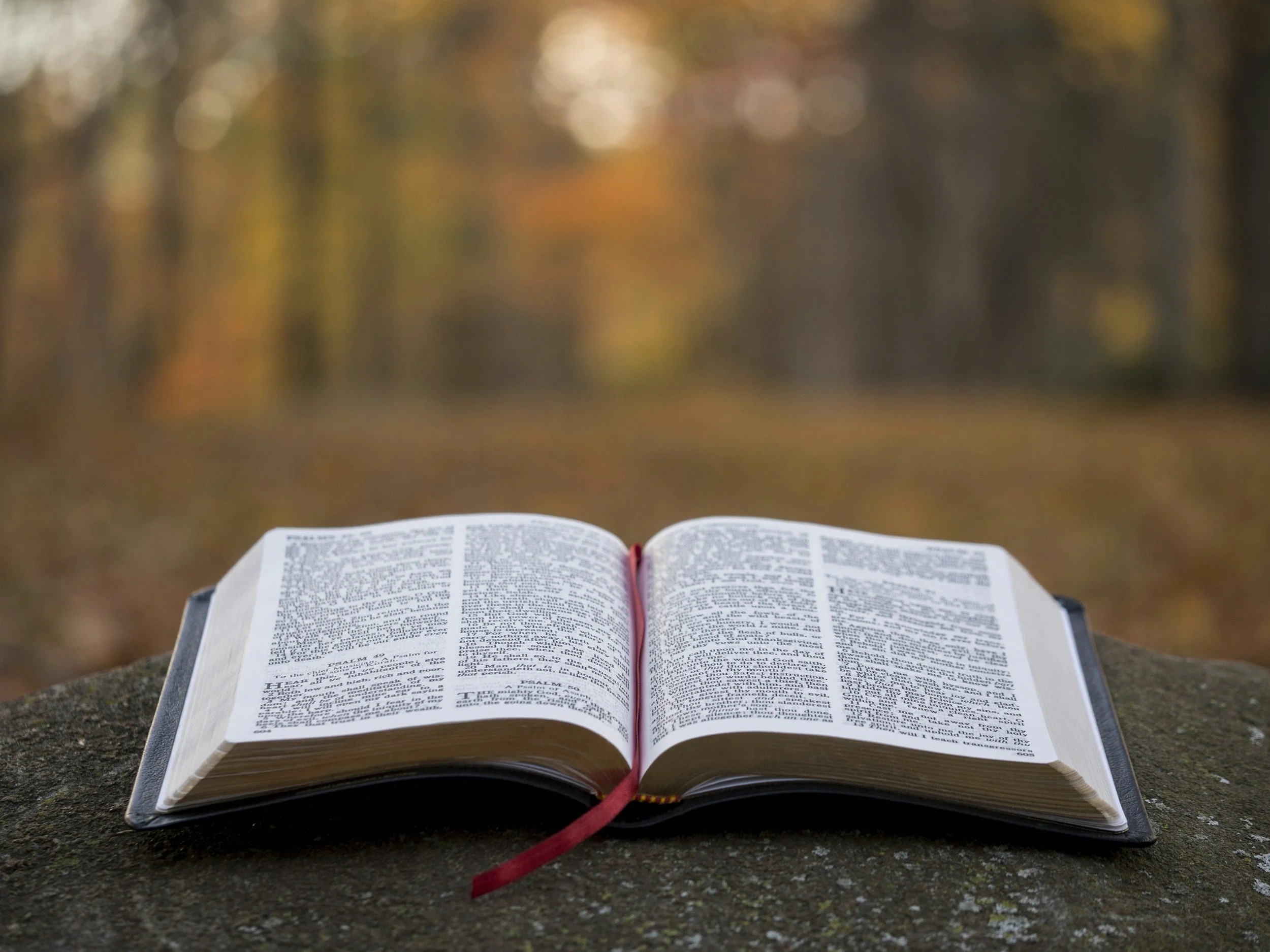
Bible Basics
Where Do I Even Begin?
Have you ever picked up the Bible and thought, "Where do I even begin?" You're not alone. Somewhere along the way, a lot of us picked up the idea that the Bible is a locked door — a thick, confusing book written in a language we'd need a seminary degree to understand. Maybe you've tried to read it and gotten lost in a genealogy, or a chapter of laws about ancient sacrifices, or a prophet whose name you couldn't pronounce, and you quietly closed the cover, wondering if it was even meant for someone like you.
That feeling is more common than you think — even people who have followed Jesus for decades sometimes flip past those same chapters. The Bible can feel overwhelming: one book telling one story, yet written by roughly forty different authors, on three continents, over about 1,500 years. Inside its pages you'll find narrative, poetry, history, prophecy, letters, and teaching. It's a lot.
But here's the good news: the whole Bible points to one person — Jesus. The Old Testament points forward to Him. The Gospels tell us about His life, death, and resurrection. The rest of the New Testament shows us what it means to follow Him and live as His people.
You don't have to understand the whole Bible before you begin. You just need to begin.
The Two Sections
The Old Testament — 39 books that tell the story of God's relationship with Israel and lay the foundation for His plan of redemption. It points forward to the coming Messiah.
"And beginning with Moses and all the Prophets, he interpreted to them in all the Scriptures the things concerning himself." — Luke 24:27
The New Testament — 27 books that tell us about Jesus, the birth of the church, and how we're meant to live as His followers. It includes history, letters of wisdom and instruction, prophecy, and four Gospels that each tell the story of Jesus from a different angle. You don't need to master this structure right away — as you keep reading, you'll start to see how all the pieces fit together, the way a puzzle starts to make sense once a few corner pieces are in place.
A simple way to picture it: the Old Testament is the long, patient setup — a promise being made and kept in pieces. The New Testament is the payoff — the promise arriving in a person.
Why Does the Bible Matter to You?
Here's the truth we want you to walk away with today: the Bible was not written to intimidate you. It was written to be read, wrestled with, and loved — by ordinary people, in ordinary life. It's not primarily a rulebook or a puzzle to solve. It's a love letter. It's the true story of a God who has been pursuing His people from the very first page to the very last, and who is still pursuing you, right now, in whatever season you're in.
"All Scripture is God-breathed and is useful for teaching, rebuking, correcting and training in righteousness, so that the servant of God may be thoroughly equipped for every good work." — 2 Timothy 3:16–17
Notice what that verse doesn't say. It doesn't say the Bible is useful for passing a test or impressing people with how many verses you can quote. It says it's useful — for you, for your actual life, to equip you for whatever is in front of you this week. That's the posture we want you to bring to this whole lesson: not "how do I master this book," but "how does this book meet me where I am?"
It's a Story Before It's Anything Else
If you remember one thing about how to approach the Bible, remember this: it is one unfolding story, not sixty-six unrelated books thrown together. It's the story of God creating a world He loves, humanity walking away from Him, and God relentlessly working — through a rescued nation, a series of imperfect kings, a long line of prophets who kept pointing forward — to bring us home. That rescue reaches its climax in Jesus, and it is still being written today, in your story and mine.
When you know that, the hard parts get easier. A confusing chapter in Leviticus or a strange vision in Ezekiel isn't a dead end; it's one scene in a much bigger story that's moving toward Jesus. You don't have to understand every verse the first time through. You don't even have to read it in order. You just have to keep reading the story, and trust that it's going somewhere — because it is.
"In the beginning was the Word, and the Word was with God, and the Word was God... The Word became flesh and made his dwelling among us." — John 1:1, 14
That's the whole Bible in miniature. God has always been speaking — through creation, through His people, through the prophets — and eventually, He didn't just send a message. He came Himself. Every page you read is either building toward that moment or flowing out of it. Once you see that, you can open the Bible almost anywhere and ask, "How does this connect to Jesus?" — and you'll almost always find an answer.
It's Meant to Be Lived, Not Just Studied
"Your word is a lamp for my feet, a light on my path." — Psalm 119:105
A lamp doesn't light up the whole horizon — it lights up the next step. That's how Scripture works. You don't need to master it before it starts helping you. You don't need a theology degree to have God speak to your Tuesday afternoon. You just need to open it and let it light up today.
"For the word of God is alive and active. Sharper than any double-edged sword, it penetrates even to dividing soul and spirit, joints and marrow; it judges the thoughts and attitudes of the heart." — Hebrews 4:12
This isn't a dusty, dead text sitting on a shelf. Christians for thousands of years — across every culture, every language, every kind of hardship — have testified that when they open this book, God speaks. Into their fears. Into their decisions. Into their grief. Into their joy. It's alive in a way no other book is, because the God who inspired it is still speaking through it.
And it's not just information — it's transformation. Reading the Bible isn't like reading a manual you finish once and set aside. It's more like a relationship: the same passage can meet you differently on a hard day than it did on a good one, because you're not just gathering facts — you're encountering a Person. Read Psalm 23 when you're grieving and it will land differently than when you read it in a season of peace. That's not inconsistency; that's a living book meeting a living person exactly where they are.
You Don't Have to Be an Expert to Begin
Jesus didn't build His church out of scholars. He built it out of fishermen, tax collectors, and everyday people who simply paid attention when He spoke and let it change how they lived. Peter couldn't have explained Greek grammar. Matthew wasn't a rabbi. And yet they became some of the most important voices in this whole story — not because they knew more, but because they showed up and stayed close.
"Blessed is the one... whose delight is in the law of the Lord, and who meditates on his law day and night. That person is like a tree planted by streams of water, which yields its fruit in season, and whose leaf does not wither." — Psalm 1:1–3
Delight — not duty. That's the posture God invites you into. Not gritting your teeth to check a box, but slowly, over time, learning to love this book because in it, you keep meeting Him. And like a tree by a stream, the fruit doesn't come overnight. It comes from staying planted — showing up again and again, even in small ways, and letting the roots go deeper than you can see.
"Man shall not live on bread alone, but on every word that comes from the mouth of God." — Matthew 4:4
Jesus said that about Scripture, quoting it Himself in His hardest moment — alone, hungry, and tempted in the wilderness. If the Bible was food for Him in His weakest moment, it can be food for you in yours. That's not a metaphor to admire from a distance; it's an invitation to actually eat. Open it when you're strong and open it when you're struggling — you'll find something different every time, because you're bringing a different hunger.
Closing Thought
You don't need to read the Bible perfectly. You just need to start — one lamp-lit step at a time. Some days it will feel like the words leap off the page and speak directly to what you're carrying; other days it will feel quiet, even confusing, and that's alright too. Growth in this book, like growth in any relationship, isn't measured by a single powerful moment but by the slow, faithful habit of showing up. The same God who inspired every word on every page is not waiting for you to get it right before He meets you there — He's already present, already speaking, already patient with wherever you're starting from.
So open it. Ask questions. Underline what confuses you as freely as what moves you. Bring your doubts as honestly as your hopes. And trust that the same story that has carried God's people for thousands of years — through exile and rescue, through silence and revival, through ordinary Tuesdays and history-altering moments — has room in it for your story too. The Bible has been waiting for you longer than you've been avoiding it. Today is a good day to start.
Take Action:
Start small. Instead of starting at Genesis 1, begin with the Gospel of John — it's written specifically to help people believe in Jesus, and it's a gentle, welcoming entry point into the whole story.
Read consistently. Set a regular time — even five minutes daily beats an hour once a week.
Ask the three questions after every reading.
What does this teach me about God?
What does this teach me about Jesus?
What does God want me to do with what I just learned?
Keep a simple response journal. After each reading, jot down one sentence: something that confused you, something that comforted you, or one question you'd want to ask your mentor.
Live it out. Pick one thing from your reading this week and put it into action.
The Conversation
What has made the Bible feel overwhelming or intimidating to you in the past?
How does knowing that "the whole Bible points to Jesus" change the way you might read it?
What's one area of your life right now where you need God's wisdom from Scripture?
What does it look like, practically, for the Bible to feel like "a lamp for my feet" rather than an assignment I have to finish?
What's one small, doable next step you could take this week to start reading — and what might get in the way of it?