
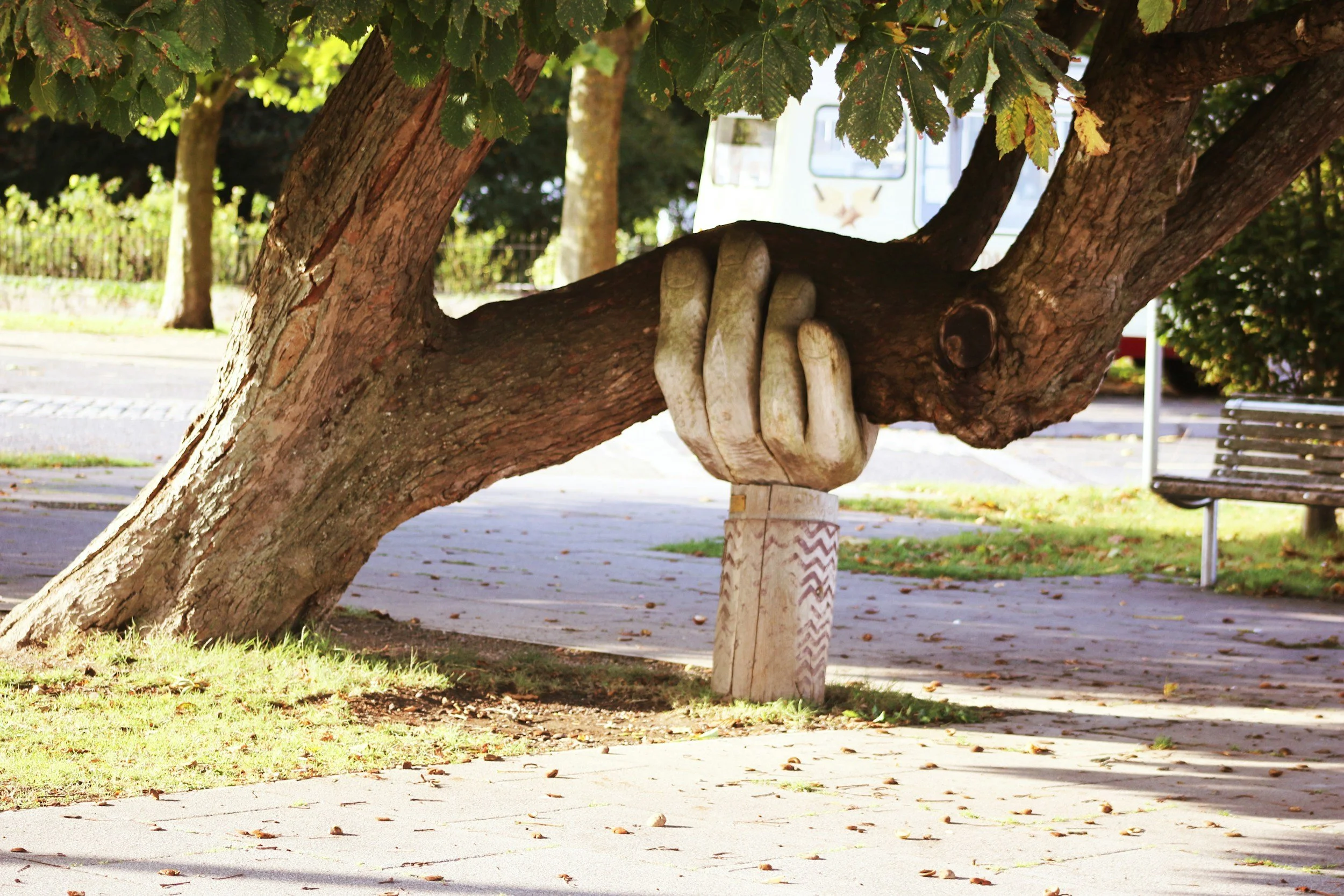
Using Your Gifts
The Circle You're Already Standing In
Look around you right now. Not out the window at the world at large — just the actual space within arm's reach. The friend next to you at lunch. Your sibling in the next room. The coworker at the next desk. The person in line behind you, scrolling their phone, waiting like you're waiting.
That's your 10-foot circle. It's not a metaphor for someday. It's not the "starter version" of your real impact. It's today, and it's close, and it's already full of people God has placed within your reach.
Here's where most of us get it backwards: we quietly believe our gifts are for the big stage. The moment we "make it." The platform we don't have yet. The opportunity that's coming, eventually, once we're more ready. So we wait. We wait to be good enough, polished enough, noticed enough — and while we wait, the people already standing close enough to touch go right on needing exactly what we were given to offer them.
Your gift was never meant to sit in storage until further notice. It was handed to you for the people already near you.
"As each has received a gift, use it to serve one another, as good stewards of God's varied grace." — 1 Peter 4:10 (ESV)
Read that command again slowly. It doesn't say use your gift once the crowd gets bigger. It doesn't say wait until you feel qualified. It says: as each has received — use it — now — to serve the ones right in front of you.
The Story That Makes It Real
Jesus told a story about three servants, each entrusted with a portion of their master's wealth before he left on a long journey (Matthew 25:14–30). The Greek word for that portion is talanton — where we get our English word "talent." Two of the servants took what they'd been given and immediately put it to work, right where they stood. The third did something that felt safe but was actually the opposite of faithful: he dug a hole and buried it. Kept it hidden. Kept it from doing anything at all.
When the master returned, he wasn't impressed by the one who'd kept his talent the safest. He was looking for faithfulness — for someone who had taken what little they'd been given and multiplied it right there in the ordinary stretch of time they'd actually been handed.
That's the whole point of this lesson: your 10-foot circle is that ordinary stretch. It is not the warm-up act before your "real" calling starts. It is where faithfulness gets tested, proven, and multiplied — or it's where it quietly gets buried.
And notice something easy to miss in that story: the master didn't hand out identical amounts. One servant got five talents, one got two, one got one — "each according to his ability" (Matthew 25:15). Nobody was compared to anyone else. Nobody was judged for not having someone else's portion. They were only asked: what did you do with what was actually yours?
That question is for you too.
Gifts Look Different on Everyone — and Your Circle Needs Yours Specifically
Paul writes to a divided, gift-confused church in Corinth and lays down a truth that should settle something in you permanently:
"To each is given the manifestation of the Spirit for the common good." — 1 Corinthians 12:7 (ESV)
To each. Not to the impressive few. Not to the ones with a platform. To each — meaning you. And the purpose clause is just as important: for the common good. Not for your résumé. Not for applause. Not to prove your worth. For the good of the people around you — starting with the ones closest.
A few chapters over, Paul gets specific about what this actually looks like in practice:
"Having gifts that differ according to the grace given to us, let us use them: if prophecy, in proportion to our faith; if service, in our serving; the one who teaches, in his teaching; the one who exhorts, in his exhortation; the one who contributes, in generosity; the one who leads, with zeal; the one who does acts of mercy, with cheerfulness." — Romans 12:6–8 (ESV)
God didn't make everyone identical, and that's not an oversight — it's design. Some people are wired to teach. Some to encourage. Some to lead, to give generously, to show mercy, to build things with their hands. Every one of those gifts is aimed, on purpose, at service — never at self.
So think about who's actually standing in your 10-foot circle this week. Classmates. Family. Teammates. Coworkers. Neighbors. Somebody in that circle needs exactly what you carry — your patience, your humor, your steady hands, your listening ear, your knack for explaining things, your simple willingness to show up when it's inconvenient. Nobody else in the world is positioned to give it to them the way you are, at that distance, today.
Small and Close Beats Big and Far
Here's the freeing part of all this: you don't need a platform, a title, or anyone's permission to start. You need to notice who's within arm's reach and be willing to bring what you've already been given.
"One who is faithful in a very little is also faithful in much, and one who is dishonest in a very little is also dishonest in much." — Luke 16:10 (ESV)
Faithfulness in the 10-foot circle isn't the minor leagues before the "real" ministry begins — it is the real thing. It is, more often than not, the only training ground you'll get before God trusts you with more. Skipping it doesn't fast-track you to somewhere bigger. It just leaves the people closest to you unreached while you wait for a stage that was never actually the point.
Your Gift Is How You Engage — Not Just What You Do
Here's the deeper shift worth catching: your gift isn't merely a task you perform on command. It's the specific language you speak that lets you actually connect with people. Engagement isn't a generic skill everyone does identically — it's personal, and it flows through whatever gift you've already been given.
Picture two people, both trying to "engage" the same friend in their circle, doing it in completely different ways — because they're built differently.
If your gift is encouragement, you engage by noticing what's true and good in people and saying it out loud — especially when someone's discouraged and can't see it in themselves. Barnabas, whose name literally means "son of encouragement," used exactly this gift to stand beside Paul when the rest of the church was still afraid of him (Acts 9:26–27), and later to give John Mark a second chance after others had already written him off (Acts 15:36–39). One well-placed word from an encourager can be the reason someone stays in the room instead of walking out of it for good.
If your gift is teaching or explaining, you engage by helping people understand something that was confusing them — a homework problem, a hard passage of Scripture, even their own tangled emotions. You make the complicated simple, and that clarity is itself a form of love.
If your gift is serving or helping, you engage with your hands before your words — showing up early, carrying the heavy thing, noticing the unglamorous need nobody else saw. Jesus modeled this at the Last Supper when he got up from the table, took a towel, and washed his disciples' feet (John 13:3–5). The King made his point with his hands, not a speech.
If your gift is mercy, you engage by being the safe person — the one people can be fully honest with because you won't flinch, panic, or judge. You sit in hard moments with people instead of rushing them toward the exit.
If your gift is leadership, you engage by organizing chaos into direction — pulling a group toward a shared goal, naming the plan people didn't know they needed until you said it out loud.
If your gift is hospitality, you engage by making room — literally, at a table, in a conversation, in a friend group — so the people who feel like outsiders stop feeling that way.
If your gift is creativity, you engage by making something that says what plain words can't — a song, a drawing, a design — something that helps a person feel understood or points them toward God without you saying a word.
If your gift is discernment, you engage by noticing what's really going on underneath — the friend who says "I'm fine" and clearly isn't, the tension in a room nobody's naming — and gently bringing it into the light instead of letting it fester in the dark.
None of that requires a stage. All of it requires proximity. And proximity is exactly what your 10-foot circle already gives you, free of charge, every single day.
Why Proximity Is the Whole Point
There's a reason the 10-foot circle matters so much: gifts don't work long-distance. You can't encourage someone you never actually talk to. You can't serve someone you never get close enough to help. You can't show mercy to someone whose story you don't know because you've never stayed in the room long enough to hear it.
"And let us not grow weary of doing good, for in due season we will reap, if we do not give up." — Galatians 6:9 (ESV)
That verse comes right on the heels of Paul telling the Galatians to "bear one another's burdens" (Galatians 6:2) — which is, by definition, close-range work. You cannot carry a burden you're not standing next to. Engagement in your 10-foot circle is slow, repeated, often invisible work. Nobody claps for it. There's rarely a highlight reel. But it is the actual harvest ground, and Paul's promise is that the harvest is coming — for those who don't give up on the small, unglamorous, close-up work.
What Disengagement Actually Looks Like
It's worth naming the quieter danger, because it's sneakier than outright burying your gift in the ground. Sometimes we don't hide our gift at all — we just stop pointing it at the people closest to us. We save our best energy, our best listening, our best effort for the people who might notice us or reward us for it, and we hand the leftovers to whoever's already in our circle: a sibling, a roommate, a coworker we've quietly stopped really seeing.
Jesus told a story about a man on the road to Jericho, beaten and left half-dead, passed by two religious men who kept walking (Luke 10:30–37). Then a Samaritan — someone with every cultural excuse in the book to keep walking too — stopped, got close, and engaged. He didn't have more resources than the others. He simply chose proximity over convenience.
The point of that story was never "be nice to strangers." It's this: notice who's actually in front of you, and don't let familiarity, busyness, or distraction talk you out of engaging them.
Your circle isn't the audience you overlook on your way to a bigger one. It is the assignment. It has been the assignment the whole time.
Closing Thought
Somewhere within ten feet of you today, there is a person who needs exactly what you carry — and no one else standing at that distance can give it to them the way you can. Your gift was never a talent-show piece meant to impress a crowd someday; it's the specific, personal way you were built to reach the people already close enough to touch. So don't bury it while you wait for a stage that was never the point. Don't ration your best self for people who might notice you more. Take what you've been given — however small it feels — and spend it close, and spend it now. That's not the warm-up for your calling. That's the calling, already in progress, right where you're standing.
Take Action:
Make a list — no filtering. Write down everything you think you might be good at or drawn to, even if it feels small (organizing, listening, humor, music, sports, art, fixing things, noticing when someone's upset). Don't judge it yet — just get it down.
Map your actual 10-foot circle. List the specific people you're closest to physically and relationally this week — family, classmates, coworkers, teammates, neighbors. Be specific with names, not categories.
Translate gift into engagement, not just action. For at least three people in your circle, don't just write "I could help them" — write exactly how your specific gift would engage them. If you're an encourager, what would you actually say? If you're gifted with your hands, what would you actually build or fix? Get concrete enough that you could do it today.
Name who you've stopped really seeing. Be honest: is there someone in your 10-foot circle — a sibling, a roommate, a coworker — you've quietly stopped engaging because they're familiar or because you're saving your energy for people who notice you more? Write their name down. That's not an accusation, it's a starting point.
Read Matthew 25:14-30, 1 Peter 4:10, and Luke 10:30-37 on your own. Sit with them for real. Journal one honest sentence: "Am I engaging the people closest to me with what I've been given, or am I walking past them on my way to something bigger?" Then do one small, specific thing this week for someone in your circle — using the gift you identified, aimed at the person you named.
The Conversation:
Who's actually in your 10-foot circle right now — and be honest, who in that circle have you been overlooking?
If you had to name your gift — the thing you naturally bring to a room — what would you call it, and where have you seen it work on someone, even in a small moment?
The lesson talks about 'waiting for the bigger stage' instead of using your gift now. Is there a place in your life where you're doing that — holding back because it doesn't feel like it 'counts' yet?
Think of someone who has engaged you well — noticed you, helped you, showed up for you. What did they actually do, and whose gift did that look like?
What's one specific way you could use what you carry for someone within arm's reach of you this week — not someday, this week?